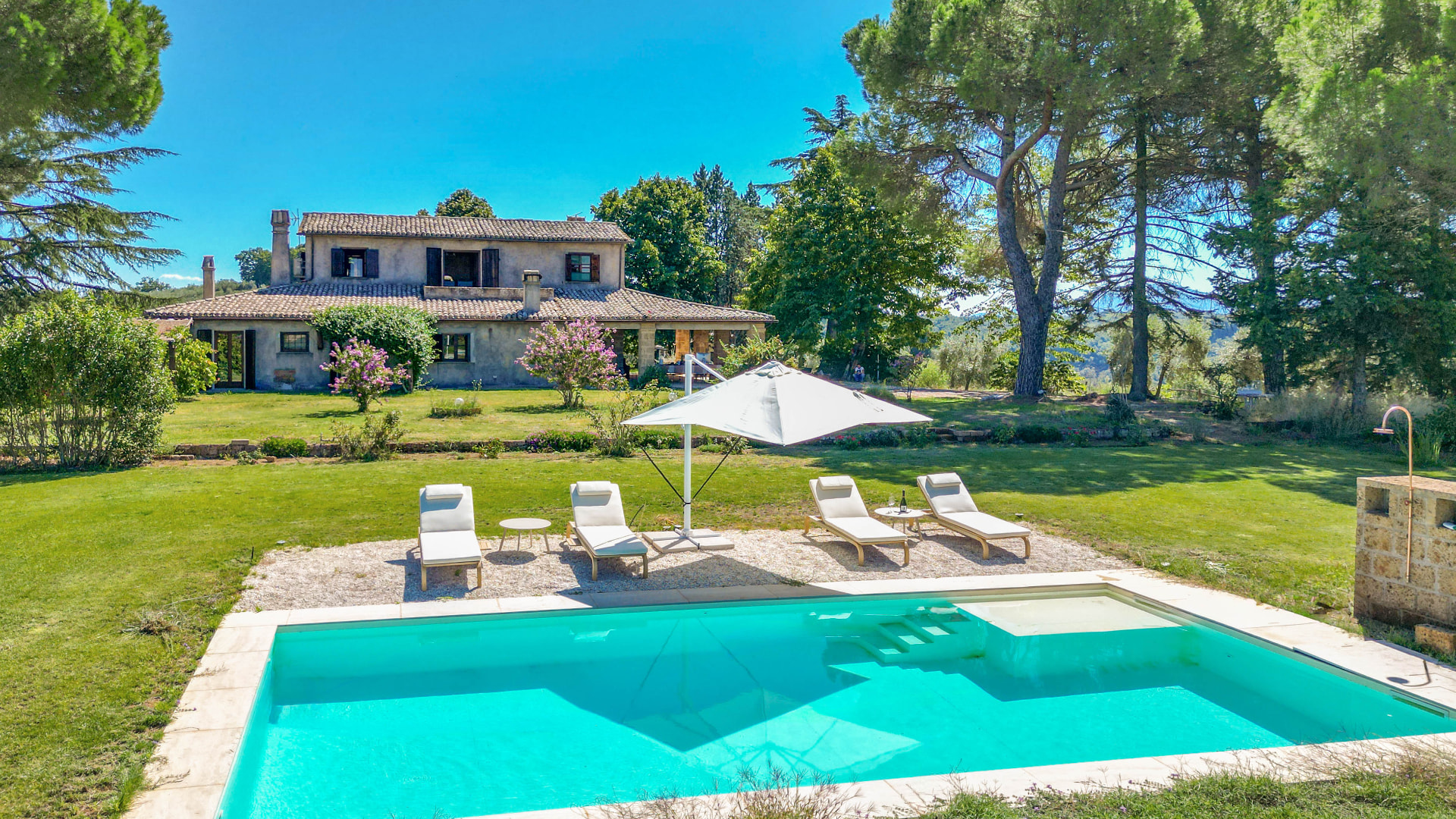
Il Casone and its garden pool with sun loungers and a white umbrella, seen from the drone

Your home in Tuscia

Il Casone

Five bedrooms, five bathrooms, generous communal spaces, five hectares of hilltop land — open fields, olive groves, a large garden and a swimming pool. Rented whole, one week at a time.

The setting

A commanding 360° view is the first thing that happens to you

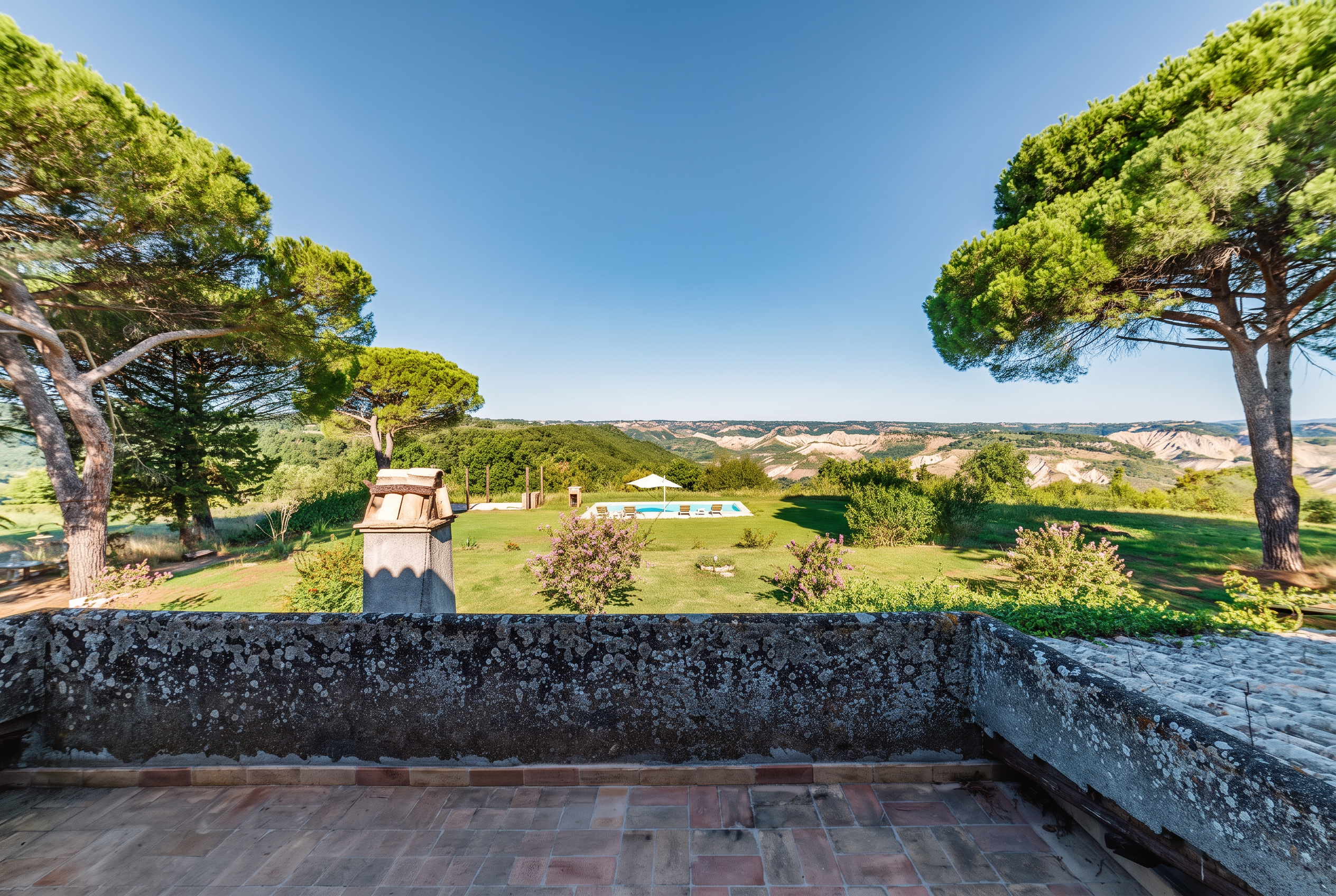
On one side the valley of Bagnoregio, its calanchi — badlands — folding away in grey-yellowish waves, with the medieval Civita hamlet balanced on its rock. On the others, olive groves, oak woods, Santa Maria XVII century castle and a horizon of Umbrian hills. The mist sits in the valley until about nine. At seven in the evening the whole thing goes copper for twenty minutes.

The house sits alone at the top of its own land. No neighbours, no shared driveway, no other guests. There is a helipad, an e-vehicle charging point, e-bikes in the barn, and a pool that faces the best of it.

Forty-four old olive trees, each giving four to six litres of oil in a normal year, and two hundred young ones we planted that produce nothing yet. Cherries, pears, apples, apricots, peaches, figs, almonds, plums and pomegranates are going in, so that from May to October the fruit on the table comes from the field, and once Monica has boiled it down to jam, it goes to the breakfast tarts too.

The terrace wall, the garden and the pool with the calanchi valley beyond

The restoration

We spent the whole budget keeping it the way it was

There is no record of the year it was built — peasant houses rarely got one. The oldest documents we found are 18th century, and Il Casone is already on them. We bought it in December 2023 and spent two full years on the restoration. Some went wrong along the way (showers floors laid with the wrong angle, twice), but one thing went unexpectedly right: under a layer of modern plaster we found an old painted wall.

Handmade terracotta, everywhere underfoot

Every floor is laid with traditional terracotta tiles; Marco in nearby Vetriolo still makes them by hand one after the other, and you have to be lucky if yours will be slotted into the next firing of the kiln. They warm in the afternoon and never look new — which is the point.
Original roofs, original beams

Rustic chestnut and oak beams carry the same handmade tiles overhead. Nothing was straightened, nothing was replaced with a copy.

Ancient doors and old furniture

You won't find two identical doors, all rescued and rehung, all different in style and size, bearing old rusty iron hardware. Wardrobes, trunks and tables with a century of use in them, local porcelain on the shelves, warm rustic lighting rather than downlights.

Rapolano travertino

Local stone for two shower walls and for the monolithic kitchen — the one openly contemporary gesture in the house.

A bathtub that was a wine cask

Because the cask was here first, and it was too beautiful to burn.

Twin LED lines in the vaulted hall

Two thin lines of light running the length of the stone vault: one of very few 21st century personal touches we allowed within these 18th century walls.

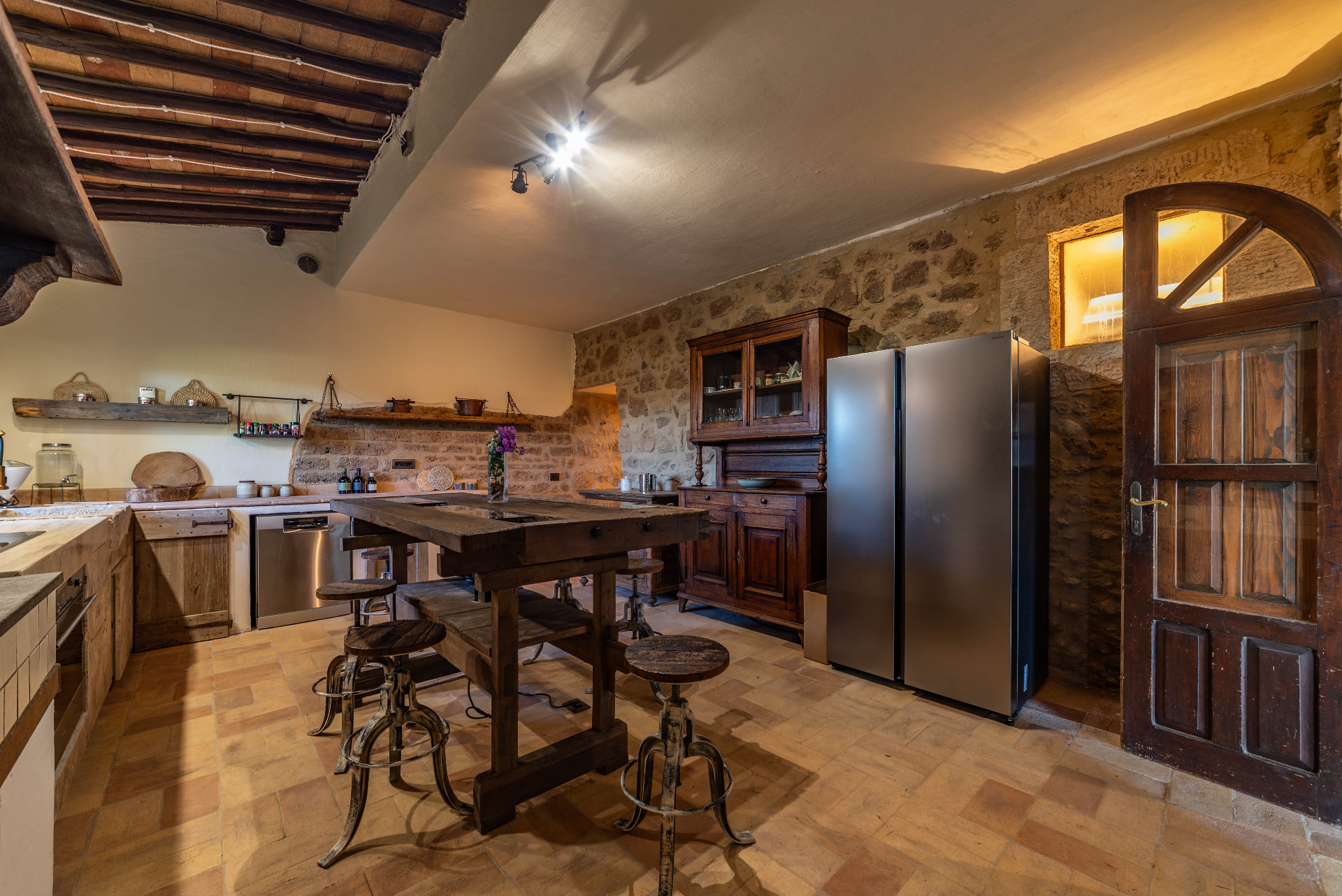
The kitchen built around an old carpenter's workbench, under the original wooden beams
The kitchen — terracotta, travertino and an old carpenter's workbench.
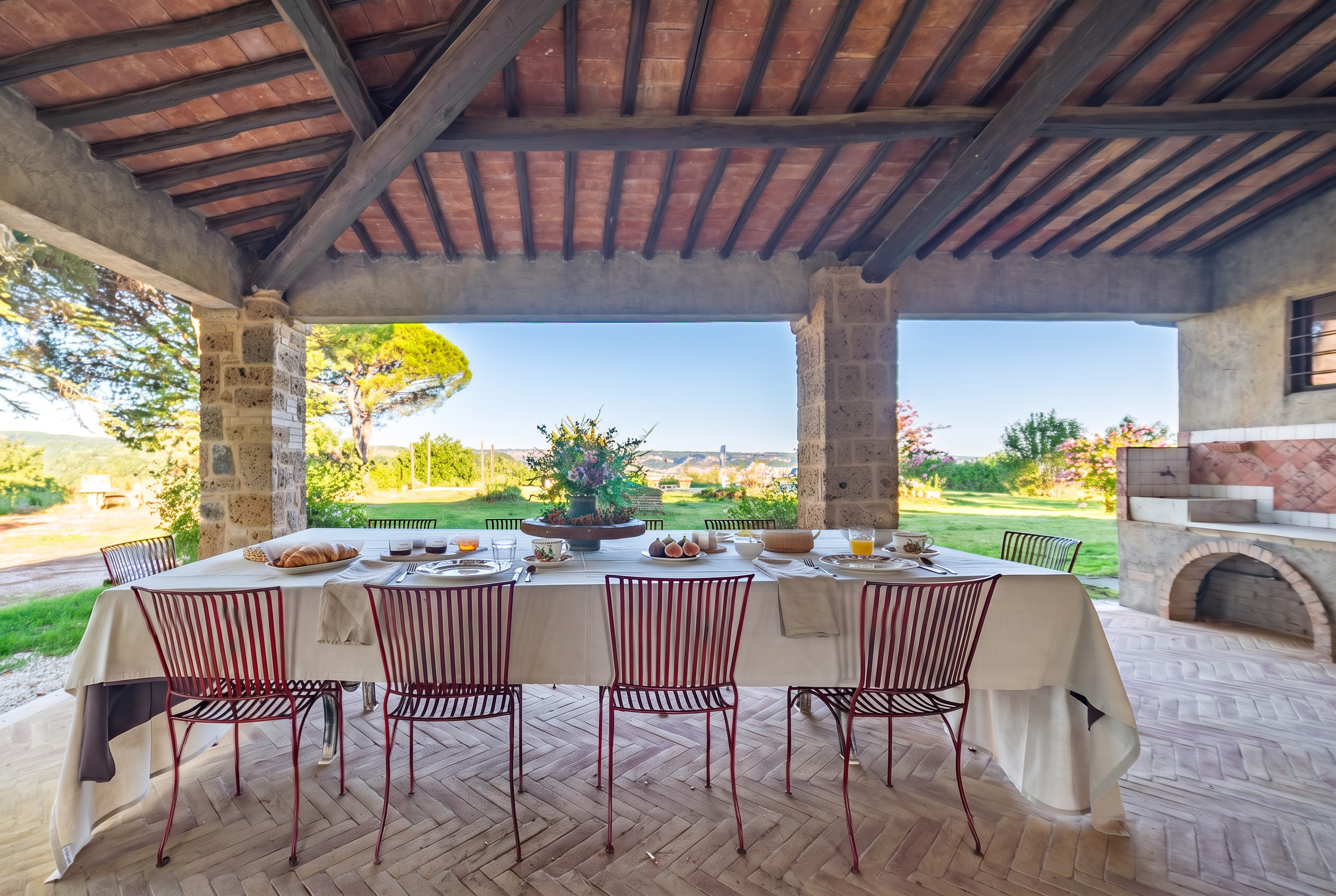
The portico table laid for a rustic, elegant breakfast
Breakfast under the portico — laid for a slow morning.

Art in the house is deliberately sparse. Alongside the rustic pieces you will find work from the Funzioni d'Onda series by Akelo — Andrea Cagnetti — a goldsmith and sculptor born in this province and exhibited well beyond it. One wave of polished metal against an old plastered wall is enough.